You
must learn to work with the cards you're dealt
Serendipity
I remember
a time in Africa 12 years ago when, on the way back from an exhausting
day's worth of shooting in Botswana (I seem to remember chasing
a monitor lizard at one point), my late mentor and noted adventure
photographer Galen Rowell suddenly woke from a car nap and started
yelling at the driver to stop. While I noted the big orange ball
of sun in front of us nearing the horizon, I looked around excitedly
for the exotic animal that Galen must have spotted. For Galen to
be so emphatic, it must be something great. Cheetah, perhaps? Black
Rhino? What? Where was it? What was it doing? Could we get whatever
it was against the sunset?
Galen
frantically dug through his gear and pulled out a body, lens, and
tripod, walked a short distance from the vehicle and started shooting...nothing
but the sunset. Now, to put this into perspective, we were in a
rather non-descript area a long way from any of the small villages,
we were on an ugly dirt road lined with trees that had seen better
days, and there wasn't an animal in sight. The locale was so awful
photo-safari-wise, that out of 14 photographers, Galen and I were
the only ones who pulled out our equipment and got out of the vehicles
looking for a shot, despite the brilliant ball of orange in front
of us. Just as I got my camera framed on the sun setting exactly
between two trees down the road, along came a jeep, coming right
out of the sun and throwing up dust to make a dramatic silouette
that lasted all of about three seconds. I got off a shot, then ran
into the field and found a termite mound to frame against the setting
sun. Another decent shot.
As
Galen and I walked back to the vehicles in the fast-gathering dusk,
I asked him "why the urgency?" Galen looked at me and
replied "You only get one sunrise and one sunset a day and
you only get so many days on the planet. A good photographer does
the math and doesn't waste either." He pointed out that I now
had a shot that none of the others in the group had, and that I
wouldn't have that shot if I just sat in the vehicle and watched
the sundown show. He went on to give me some advice: "Most
of my best sunrise or sunset shots were taken because I planned
to be there. Sometimes I had to go back multiple times to get the
shot, sometimes I just happened to see a cloud and knew where I
needed to be when the light changed. But even if you don't have
a plan, there's always serendipity. Look around and find the thing
that stands out. Couple that with some photographic skill and a
little physical ability, and almost every sunset can provide you
something to shoot."
Redux
Two
weeks later I was in a boat on the Chobe River. I suddenly realized
that the sun was setting behind me and I hadn't planned anything
(I hadn't realized that I'd still be on the boat when the sun set).
The boat was heading away from the sun, so I moved to the back of
the boat. As luck would have it, a local poled by in his dugout
just as the last rays of sun were visible:
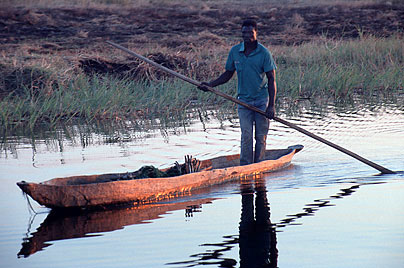
But
since I couldn't position our boat, I couldn't get the sunset behind
him. Then I noticed the patterns his boat and ours made in the water,
and after a few moments of fiddling, I produced this photo:
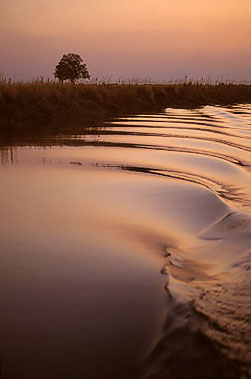
I have
a few things to say about this photo. First, for reasons I'm still
not completely sure of, I like it a lot. I think one factor is sentimental:
this was one of the first photographs I took upon retaking up photography
where it's all about mood and feeling, something that's
not easy to do. The photo has a simplicity, quietness, and sureness
to it than mimics what I felt at the time. It's also not like any
other shot I took that week, which says something important, as
well: I was pushing myself beyond what I would normally do. I was
using my skills to capture what I envisioned and what I felt, not
simply trying to record what was in front of me.
Some
may say that there's a better horizontal shot here (to see it crop
a bit of sky and the entire bottom half of the image). I actually
took that shot, too. But I didn't like it as much as this one, because
there's another thing going on here: this part of Africa seems to
extend to foreever and can seem so barren and empty, yet so full
of color and detail. Anyhow, whether you like the shot or not isn't
the point. The point is that I was fully cognizant of what Galen
had said at the start of the trip, and I was trying to put that
into action. And it produced a shot I liked that I wouldn't have
taken otherwise.
Practice,
Practice, Practice
Okay,
so now let me take you through a modern day version of that same
set of lessons. It happened at one of my Hawaii workshops in 2002.
After the long day of driving (and ocassionally stopping to shoot)
from Kona to Volcano House, I was dog tired and made the silly decision
that we'd simply check in, pop out onto the veranda and see what
was happening at sunset (where was Galen to kick me when I needed
it?). However, I did note as we drove up to the hotel (which is
situated on the edge of a caldera) that some sort of front was coming
up over Kilauea and the cloud pattern was getting more interesting.
By the time I checked in, took my bags to my room, unpacked a few
things, and came back down to the veranda, this is what I saw:
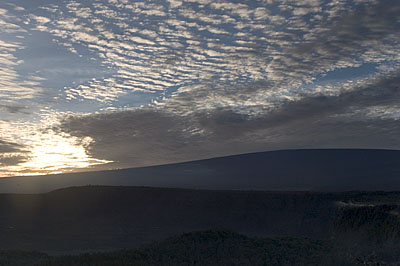
The
workshop students weren't quite sure if this was going to get better,
but having been here a number of times before, I knew that the sun
had a pretty good chance of getting underneath all of the clouds
on the other side of the volcano and producing a light show. We
were all tired, but I got out my camera and encouraged them to do
the same. Within a few minutes the sky changed dramatically:
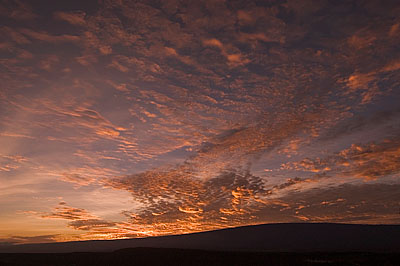
Okay,
so now what? If you know anything about the location of Volcano
House, you'll know that you don't have a lot of convenient options
compositionally, despite the nice view. Once light leaves the caldera
floor, it's difficult to include it. But I gave it a shot, anyway:
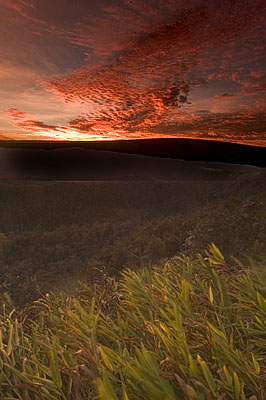
Like
I said, not much light in the caldera, and given the properties
of digital cameras, it's very difficult to keep any detail in the
dark area. So I decided it was time to experiment. One of the things
I advocate students do is to break the basic rules of composition.
So I tried breaking one (Horizons must be Horizontal):
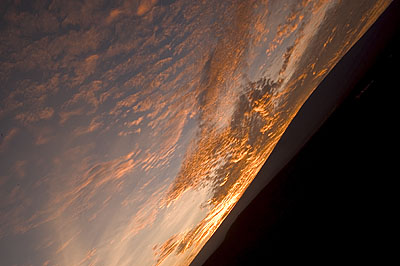
Feel
like you're in a plane spiraling to your death? So do I. But looking
through the viewfinder dispassionately at this started to tell me
what was wrong: other than the sky, we have nothing of interest.
And even with the sky, we have no sense of place, whatsoever. I
eventually noted that there were intermittent puffs of smoke out
of the caldera:
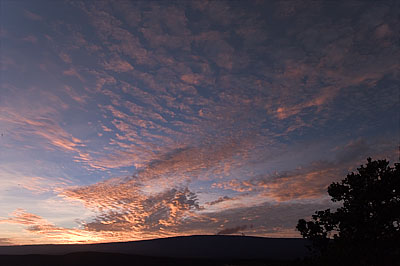
In
order to get the smoke visible (it's just to right of the peak of
the land silhouette), I've had to do a bit of postprocessing. Here
I've downplayed the color temperature a bit to bring back some blue
to the sky (D1 Report readers may also recognize my Digital Velvia
action at play here), then increased the luminosity of this whole
area a bit.
In
the end, though, I couldn't quite get the shot to be about anything
but the sky, so I finally went with that, and produced this image:
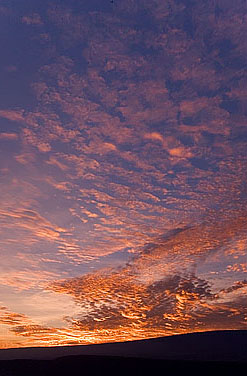
I've
taken better images than this, by far. And there's no sense of place.
So why did I take it and what did I learn? Well, it was the only
sunset that occurred that day (as Galen would say) and I didn't
let it slip away unseen and unexperimented upon, despite my poor
location choice. But more important, I've now seen this cloud pattern
twice at Volcanoes National Park, and I've done a bit of scouting
to figure out how to get a sense of place into my photo if it happens
again. So, when I'm in Hawaii again later this year, I'll be keeping
my fingers crossed that the pattern repeats again. This time, I
know exactly where I'll be if it does.
Great
photos don't happen by chance.
|